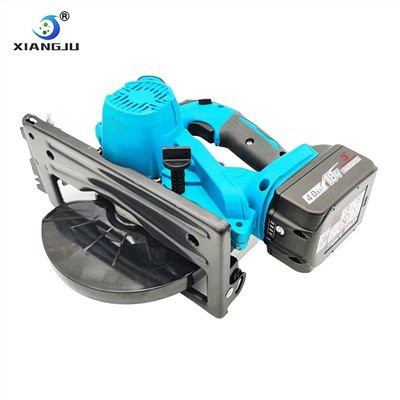
Power Circular Saw Features
Depth adjuster
A depth adjuster function can be found on some circular saws and table saws. This feature allows you to raise or lower the height of the blade so that it cuts at different depths.
Length of stroke
This refers to the distance the blade travels up and down on saws, like jigsaws and reciprocating saws. For example, if the stroke length on a jigsaw is 20mm, then the blade will move 20mm down and 20mm up in one stroke. The longer the length of stroke, the faster the saw will cut.
Beveling shoe
This feature can be found on circular saws, table saws and mitre saws. They allow the blade to be tilted to cut a bevelled edge.
Mitre cut
This feature can be found on mitre saws and table saws with tilting blades. They allow the blade to be moved to cut angles.
Parallel guide
This is a standard feature on most circular saws. It's a guide that provides a straight edge to cut against at a set distance from the edge of the material being cut. It ensures the straight line is cut accurately.
No load speed
This is the speed at which the blade on a saw travels up and down, forwards and backwards, or in a complete circle (depending on the type of saw). The speed is measured when the saw isn't cutting (so the speed will decrease when it is).
Strokes per minute
This is the speed at which the blade on a saw travels up and down, forwards and backwards, or in a complete circle (depending on the saw type) in one minute. The higher the strokes per minute, the faster the saw will cut.
Variable speed
This feature on saws allows you to vary the speed of movement of the blade. This is a useful feature because different applications and materials often require different speeds.
Universal blade clamp
This feature applies to jigsaws and the way blades fit into them. There are two types of blade fitting: T shank and U shank. Some jigsaws only accept one type, but a jigsaw with a universal blade clamp can take both.
Pendulum action
This is another feature applicable to jigsaws. Jigsaws have reciprocating blades that move up and down. But the blade on a jigsaw with pendulum action also travels backwards and forwards. This helps the blade to cut faster. It's useful for making rough cuts quickly but not for clean cuts.
Maximum cutting capabilities
This is measured in millimetres and indicates the maximum depth of material the saw can cut. There are often different measurements for the different types of material the saw can cut.
Keyless blade change
Some power saws require a separate tool or 'key' to unlock the mechanism holding the blade in place. However, a power saw with a keyless blade change function doesn't require a key, making a blade change quicker and easier.
Dust extraction
Some power saws come with a dust extraction device. This is like a vacuum that sucks up the dust as you saw, so less mess is made. It also prevents you from breathing in harmful particles.
Blade bore diameter
This feature applies to circular saws. It refers to the diameter of the hole in the blade's centre (called the blade bore) where you attach it to the machine. These holes vary, so you must buy the right blades for your saw.

How to Use Power Circular Saw
First things first, you're going to want to mark out where you want to cut. Take note of the 0° marking, or two 'notches' on the base plate (see photo) as this is in line with where the blade will cut. You always want to follow along this 0° mark when working freehand without a rail. Alternatively, you can follow the blade by looking at it from the side. But please note, this may not provide entirely straight cuts.
● Mark out where you want to cut.
● Clamp the material firmly to your workstation or set up your guide rail
Adjust your base plate to the correct height so that the blade is ever so slightly lower than the material you're cutting.
● Set your bevel angle if you are using.
● Rest the shoe/baseplate on the edge of the material and near the cutting line, but don't let the blade touch it yet.
● Pull the trigger and allow the blade to reach its maximum rpm before starting to cut.
● Once its reached its optimum speed, slowly push the circular saw through the material.
● Once you have cut through the material, release the trigger and allow the saw to fully come to a stop.
You always want to cut in a position that allows the offcut piece of material to fall to the ground. Don't saw in the middle of two surfaces as this can cause kickback, splintering and injury.
How to Make Straight Cuts with Power Circular Saw
Whilst we always recommend you use a guide rail when cutting larger sheets of material, there are a few alternative methods for making straight cuts in smaller materials. A speed square is a good option for making straight cuts in smaller boards. Our image shows how to do so, but it is as simple as running the base plate of your circular saw along the side of the square to achieve a straight cut.
A spirit level and 2 clamps is also a good option for larger materials. Clamp the level to the workpiece and similarly to the speed square, follow the side of the level to achieve that straight cut. Most circular saws also come with a guide fence included as standard, which slots into your saw and allows for straight cuts.
If you are making cuts that don't need to be entirely straight, you can simply cut using freehand as explained above. Remember, a guide rail will always be the safest and most accurate method.
How to Sharpen a Power Circular Saw Blade
When the teeth on your saw blade start to become dull, most people assume its time to purchase a new one. Whilst there is absolutely nothing wrong with this, did you know you can actually sharpen your saw blades?
Saw blades can be expensive, and if you are using them regularly, they can lose their sharpness fast. Using our method below will help to save you money and increase the lifetime of your blades.
To sharpen your circular saw blade, all you have to do is:
● Remove your saw blade from the machine.
● Clamp it in place with a vice.
● Using a flat file, sharpen each individual tooth on the blade. It only requires around 3 strokes per tooth.
What Type of Finish Can I Achieve with Power Circular Saw Blade
The blade you buy and fit onto your saw will produce a cut specific to the manufacturer's design. The type of cuts achievable are normally:
Very coarse cut
Fast rip cuts and cross cuts in softwood, hardwood, raw chipboards and formwork boards.
Coarse cut
Rip and cross cuts in softwood, hardwood, raw chipboards, formwork, boards and plywood.
Fine cut
Cross cuts in softwood, plywood, wood core plywood, chipboards laminated on one side, and parquet.
Very fine cut
Cross cuts in softwood, hardwood, plywood, wood core plywood, parquet, fibre materials and MDF.
What to Look for When Choosing Power Circular Saw
The main things you should be looking out for when choosing power circular saw are cutting capacity, cutting depth and bevels. The capacity and depth of your cut with power circular saw is based on the size of the saw's blade.
Pay close attention to the type of blade supplied with – or available for – your power circular saw. Using the correct type of blade for the application you're undertaking is essential if you want to get the most out of your circular saw. It's also essential for your health and safety. See our range of circular saw blades.
The depth of cut achievable from your power circular saw varies from manufacturer to manufacturer, so look out for the maximum cutting depth at 0°. That's how deep you'll be able to cut when the saw isn't being used to cut a bevel, which is achievable if the saw has an adjustable base plate.
For example, one saw may not cut as deep as another at 0° but will cut deeper when at a 45° bevel. So, what sort of cut matters more to you; cutting straight into the material, or at an angle? Choose your circular saw accordingly.
● Speed and control: The faster the motor can turn the blade, the more control you have over the cut. That's about all we can say about this! Look out for the revolutions per minute (rpm) of the cordless circular saw you're interested in.
● Extra features: Most of us like some nice extra features and benefits to our power tools that the manufacturer has built in to help us get the job done safer etc.
The motor on a circular saw is liable to be placed under extreme stress if you're cutting long pieces of hard timber. So look out for safety features built into the motor, such as protection against burning the motor out, fans to keep the motor cool or advanced braking systems that immediately kill the motor and stop the blade in an emergency.
Other features like LED job lights are useful, as is the exclusion of a riving knife, the absence of which makes plunge cuts easier.
Look out, too, for ergonomic handles and the overall weight of the saw. These are key ways to determine how long you'll be able to use the saw before your hands and arms get tired.
How to Change a Power Circular Saw Blade
You will need to change your saw blade every so often depending on the material you're cutting and the finish you wish to achieve. If you aren't sure which circular saw blade you should be using, you can refer to our circular saw blades buying guide. To change the blade on your circular saw, simply follow the steps below:
● Look out your hex key. This usually comes supplied with the tool and can be found stored on the body of the tool.
● Lock the blade in place by pushing in the lever on the body of the tool (if you tried to unscrew the bolt without doing so, the blade will just turn and it wont loosen).
● Insert the hex key into the bolt and unscrew fully.
● Remove the flange and your blade should slide right out.
What Power Circular Saw Blade Do I Need
The cut performed by the blade actually comes solely from the teeth, rather than the disk itself. Therefore, the type of teeth on the blade you choose will have the biggest impact on the material. Choosing the correct tooth-type is essential, both in terms of cut quality and personal safety.
First of all, the greater number of teeth on the blade denotes a finer, more accurate cut.
The high number of teeth, coupled with the thinness of the blade, means that it's ideal for fine, accurate cuts in parquet and laminates. And because the teeth (or blades) are made of tungsten carbide, they're extremely hard wearing and they can be re-ground, allowing you squeeze plenty of working life out of them.
Another factor to consider is the shape of the blade's teeth. The shape of the teeth cut into the tungsten blade affect the quality of the cut you'll achieve. Some examples of shaped teeth are alternate top bevel. This is where one bladed tooth slopes one direction, the one behind it slopes in another direction. Teeth like these are ideal for fast cuts, perhaps through rough wood, particularly along or across the grain.
Perhaps the most obvious, but also the most overlooked, is to make sure you buy and use the circular saw blades at the right height. When buying and using circular saw blades, it isn't just a case of making sure you've purchased the correct size of the blade with the correct shape and number of teeth for the application, but that you're using the blade at the correct height in your machine.
The blade, or disk part, is only there to – literally – support the teeth. Therefore, setting your machine to the correct height (or depth) of cut will determine whether you're getting the most out of the blade and not putting your machine under too much stress. When cutting, the teeth of the blade should only just be protruding from the cut, no more than a couple of millimetres or so. This means the teeth will be making contact with your cutting material at the correct angle, your machine will be able to operate at the best speed for the cut and you'll experience less resistance and vibration.
Parts of Power Circular Saw
Power circular saw is made up of many parts, all of which serve a purpose. Before we get to cutting, we need to know what each part is called and what its job is to do.
Blade - The most important part, this is what will cut the material.
Blade guard - Prevents wood from falling onto the spinning blade and covers the blade when the saw isn't in use to prevent injury.
Shoe/baseplate - Slides over the material you're cutting.
Two handles - One on top and one at the front to help guide the saw.
Bevel adjustment - Allows you to adjust the bevel of the saw for cutting at different angles.
Depth adjustment - Allows you to adjust the cutting height of the saw for cutting different depths of material.
Trigger switch - The power on/off button.
Hunan Yuanju Power Tools Manufacturing Co., Ltd is a leading manufacturer of lithium cordless power tools, we manufacture DC electric brushless and cordless wrench, electric drilling machine, electric rotary hammer, chain saw, circular saw, tiles paving machine, saber saw, angle grinder, reciprocating saw, electric shear, lithium screwdriver, air blower/ dryer, all are lithium powered with innovative design, high quality, fast delivery, competitive price and superior after-sales service.


Q: What is a power circular saw used for?
A: Circular saws are a type of power tool designed to cut through wood and other construction materials. They feature a sharp circular blade which rotates at speed to create cross cuts and rip cuts and are available in a few different sizes determined by the size of blade they accept.
Q: What are the 2 types of circular saws?
A: Circular saws are hand-held power tools with high-speed steel blades designed to cut wood and other materials. Circular saws come in two main designs, the worm drive and the sidewinder. A worm-drive saw has a motor with more torque, making it easier to cut thick, difficult materials like hardwoods.
Q: What is the use of power saw?
A: The portable electric circular saw, with the blade attached to a motor shaft, is probably the most commonly used saw, particularly by home handymen. With the proper blade it can cut almost any material—wood, metals, plastics, fibreglass, cement block, slate, and brick. On wood it can rip, crosscut, and make angle cuts.
Q: What power is needed for a circular saw?
A: The typical amperage for small power tools (sander, jigsaw, etc.) is 2 to 8 amps. For larger power tools (router, circular saw, table saw, lathe etc.), 6 to 16 amps is typical.
Q: What saw is best for cutting wood straight?
A: The best saw type for cutting straight lines is a circular or table saw. But a jigsaw is best for cutting curves or shapes.
Q: What is the best saw for cutting wood for beginners?
A: For most, a circular saw is a great place to start, but avid DIYers will quickly find a use for a miter saw, a table saw, and eventually, every saw on this list.
Q: Do circular saws only cut straight?
A: There are two types of straight cuts a circular saw can make on a piece of lumber. A crosscut is a cut against the grain of the wood, such as when trimming a length of board to size. A rip cut goes with the grain of the wood and is usually a longer cut.
Q: What size circular saw is best?
A: The most common blade diameter is 7-1/4 inches. Most saws with blade capacities of 6 inches or more can cut through 2-inch dimensional lumber at a 45-degree angle in a single pass. A 5-3/8-inch saw can cut through 2-inch dimensional lumber in one pass at 90 degrees but requires two passes at 45 degrees.
Q: What is the most common power saw?
A: A circular saw, also called a buzz saw, is one of the most popular types of powered saws on the market. It uses an encased circular blade that cuts in a rotary motion. The base of the saw will be flush with the material you're cutting to hold it in place.
Q: Which power saw is most versatile?
A: If you just have one power saw for home improvement work, a circular saw is a good choice as an all-around wood-cutting saw. A circular saw is small, portable and highly versatile. As long as you have a suitable blade, circular saw uses can include: Making quick crosscuts and rip cuts.
Q: Do cordless circular saws have enough power?
A: While there's still a performance gap between corded and cordless circular saws, most cordless models now have the cutting power to handle just about any job.
Q: How many amps is a good circular saw?
A: Today, 15-amp saws are the standard; 10- or 12-amp saws are appropriate only for infrequent use
Q: What saw is best for cutting plywood?
A: If you have a circular saw, it's one of the easiest and most versatile tools for cutting plywood. Additionally, a table saw is excellent for making straight and precise cuts in plywood, while a jigsaw is ideal for curved cuts or irregular shape.
Q: What are the three basic types of saws?
A: Jigsaws, circular saws, and reciprocating saws are all portable power saws, but they are used to make different types of cuts. Similarly, chop saws make straight, vertical cuts, while miter saws or compound miter saws can make straight, angled, or mitered cuts.
Q: What size circular saw is best for DIY?
A: Compact circular saws: A lighter, more portable version of the full-size saw. The 5-1/2″ blades can cut up to 2″ depth. It is handy for general DIY tasks, especially when you need to make cuts in tight spaces.
Q: Is a jigsaw better than a circular saw?
A: It depends on your needs. If you're looking to do some serious work and need to cut through boards quickly, then a circular saw is the better option for you. But if you're working on more intricate shapes or detailed number cutting, then a jigsaw is going to be your best bet.
Q: Why are so many circular saws left handed?
A: A cordless circular saw typically has the blade on the left so that the operator can see the cutting line and make more accurate cuts. This is because most people are right-handed, and having the blade on the left allows the operator to hold the saw with their dominant hand and guide the saw with their other hand.
Q: Why stand to the side when using a circular saw?
A: Kickback is one of the most common ways injuries occur when using circular saws and similar tools. This happens when the tool or the material unexpectedly jolts back at force towards the user.
Q: What size circular saw blade to cut 2x4?
A: The least number of teeth you will find on a circular saw blade is about 14. A circular saw blade is only 7-1/4 inches in diameter. Fourteen teeth are ideal for the rough cuts on 2x4 framing lumber, and they cut very fast.
Q: What is the most versatile saw for beginners?
A: A miter saw (sometimes called a chop saw) is best used for cutting down the lengths of lumber that is not very wide or thick, like 2x4s, trim pieces, furring strips or shiplap. The miter saw is usually the #1 saw I recommend for beginners that want to get into woodworking because it is so easy to use and versatile.